How to practise 20 minutes a day and actually get better
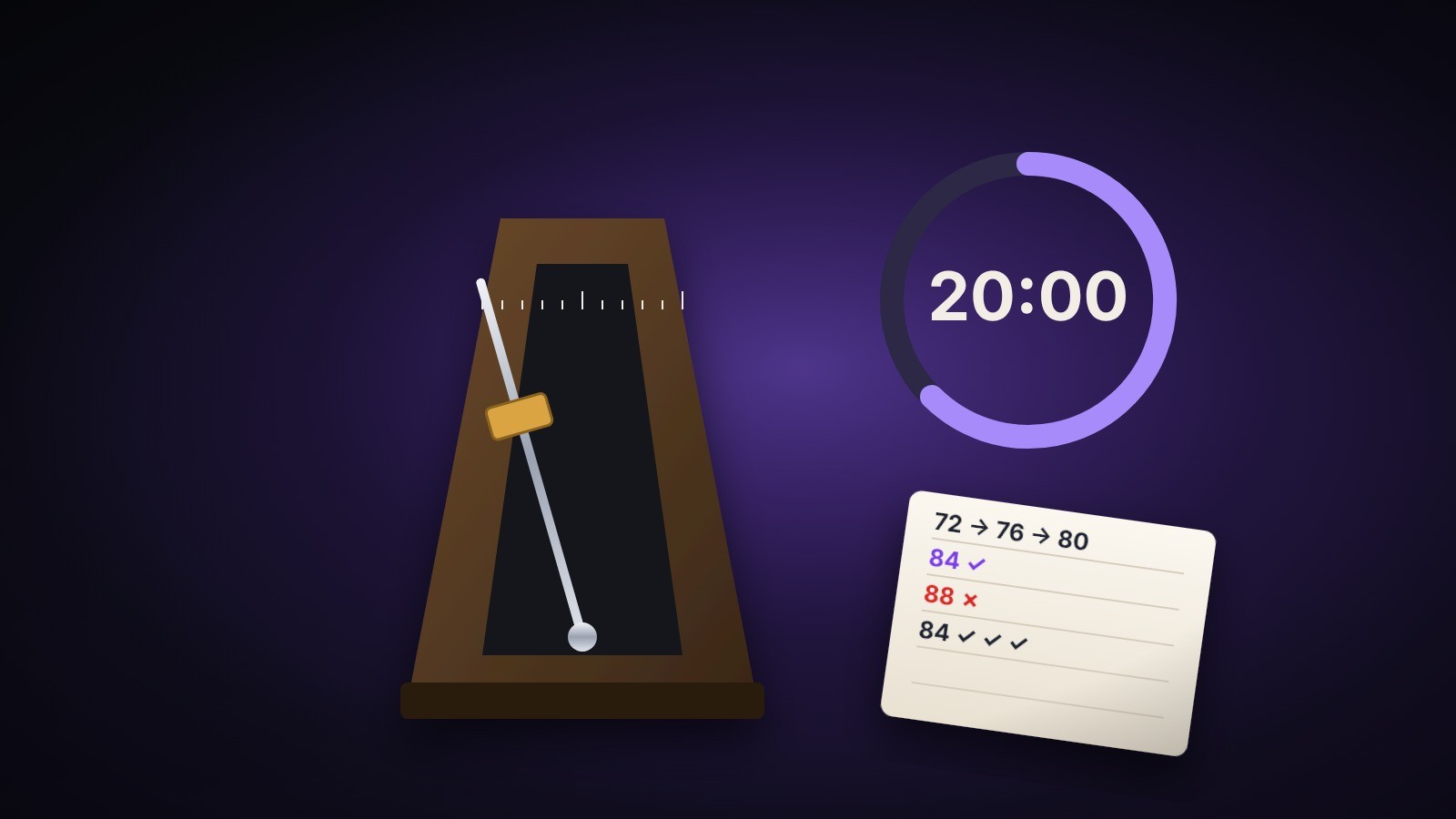
For about ten years I practised the way most self-taught people do: when I felt like it, for as long as I felt like it, playing the things I could already play. Some weeks that was three hours a day. Then a month of nothing. The graph of what I could actually do was flat, with a bump every time I learned a new song and forgot the previous one.
What changed wasn't talent or free time. It was that I stopped treating practice as a mood and started treating it as a twenty-minute appointment with three tools: a metronome, a notebook, and a number. This is what that looks like now, with the Practice section on Sonetum doing the bookkeeping for me, because that's exactly what I built it for.
Why twenty minutes, not two hours
Two reasons, one boring and one interesting.
The boring one: twenty minutes is small enough that you'll do it on a Tuesday after work. The best practice schedule is the one that survives a bad week. A plan that needs ninety minutes gets skipped the first time life happens, and then it gets skipped the next day because "I already broke the streak."
The interesting one: your hands don't learn during the session. They learn afterwards, while you sleep, and the thing that gets consolidated is whatever you did right before you stopped. Six short sessions across a week beat one long one on Sunday, even if the Sunday one is longer in total. Daily repetition is the ingredient; duration is seasoning.
So: twenty minutes, most days. Not every day. Most.
What goes into the twenty minutes
The trap with a short session is spending all of it warming up and playing the intro of the thing you like. Here's how I split it, and the split matters more than the exact numbers.
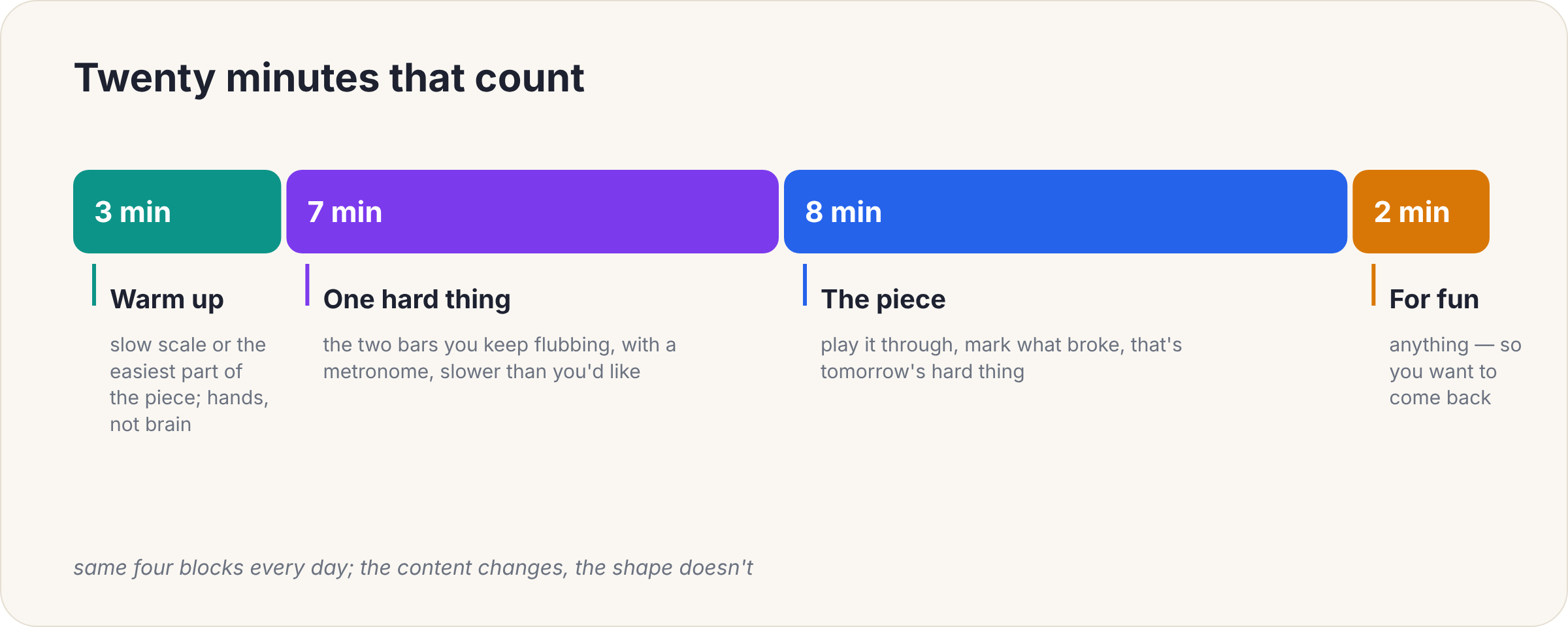
Three minutes of warming up. Something slow and boring. Chromatic runs, a scale, long tones if you're a wind player. The point isn't to practise this; it's to make your hands warm and your attention land on the instrument.
Seven minutes on one hard thing. Not "the song." One bar, one transition, one lick that keeps falling apart. The smallest unit that is still broken. This is where the metronome lives, and I'll come back to it.
Eight minutes on the piece. Now the actual song or étude, start to finish or at least a whole section, at a tempo where you can get through it. Here you connect the hard thing you just drilled to its neighbours.
Two minutes for fun. Noodle. Play the riff you love. Improvise over nothing. You end the session wanting more, which is the only reason you'll come back tomorrow.
If you only have ten minutes, cut the warm-up to one and the piece to four, and keep the seven minutes on the hard thing. That's the part that moves the needle.
The metronome is not a punishment
Everyone's been told to practise with a metronome. Almost nobody does, because the usual advice is "play the song with the click" and that's miserable: too slow and it feels pointless, too fast and it's a train wreck.
Here's the version that actually works. The metronome is a ladder, and you only climb one rung at a time.
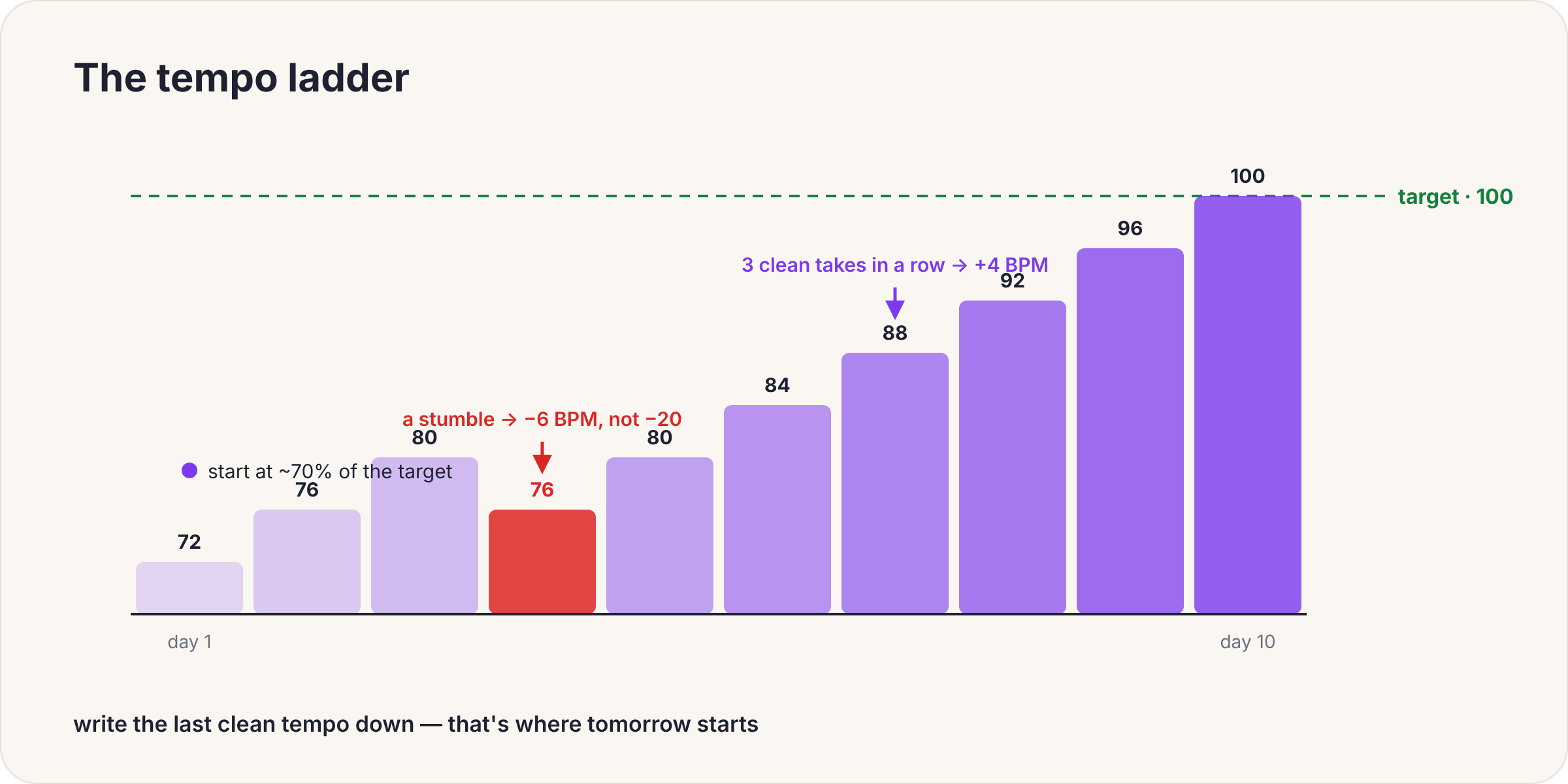
- Take your one hard thing. Find a tempo where you can play it cleanly three times in a row. Not "mostly." Cleanly. For most people that's around 60–70% of the target, and yes, it feels embarrassingly slow. That's the start.
- Three clean takes in a row → tempo goes up by 4 BPM. Not 10. Four.
- A stumble → tempo goes down by 6 BPM and you earn it back.
- When the seven minutes are up, write down the tempo you ended on. That's your number for tomorrow.
The asymmetry (up by four, down by six) is the whole trick. It means you spend most of your time at a tempo where you succeed, and your hands learn the right motion instead of a sloppy approximation of it. Speed is a side effect of accuracy repeated. You cannot get there in the other order.
Two things people get wrong here. First, "clean" includes rhythm, not just the right notes. If you land the notes but the timing wobbles, that's a stumble. Second, don't set the metronome to click every beat at slow tempos; at 60 BPM, set it to click on two and four, or on one only. It forces you to keep time between clicks, which is the actual skill.
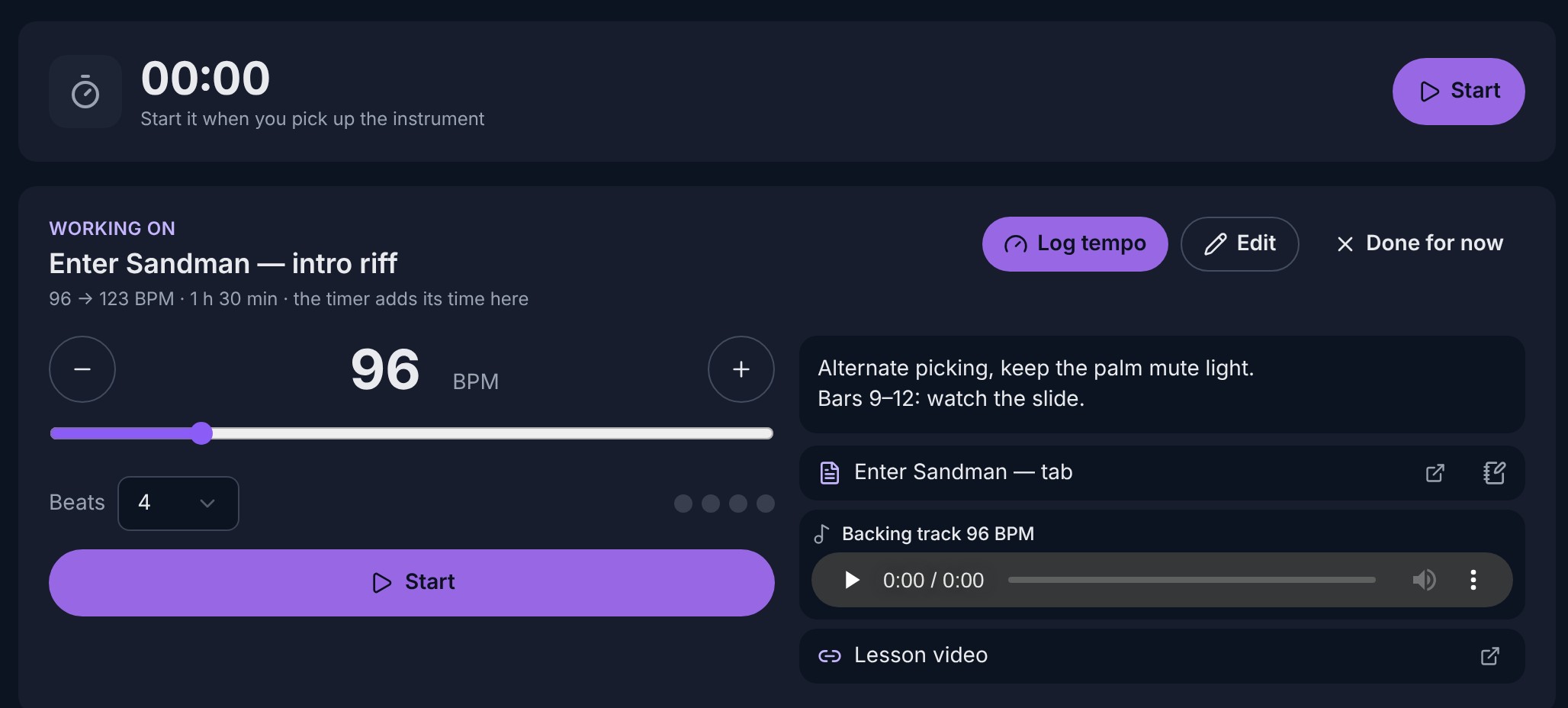
On Sonetum this is built into the card for whatever you're working on: a metronome with a BPM slider, the current tempo, the target tempo, and a "Log tempo" button so the number you end on gets written into your diary without you opening a notes app.
The notebook (or the diary)
This is the tool nobody uses and everybody should. A practice diary doesn't have to be literary. Mine is three lines a day:
- what I worked on
- the tempo I ended on
- one sentence about what broke
"Enter Sandman intro, 96 → 100, the slide in bar 11 is late." That's it. Twenty seconds.
Why bother? Because memory lies. Without a diary you feel like you're not improving, because today's playing always sounds like today's playing. With a diary, you flip back a month and see 72 → 100 on the same riff, and it is impossible to feel stuck. The diary is where the motivation comes from, not the other way round.
The second thing a diary does is stop you re-deciding every day. You open it, you see yesterday's number and yesterday's problem, and you start there. No warm-up of "what should I even practise," which, if you're honest, is where half of a lot of sessions used to go.
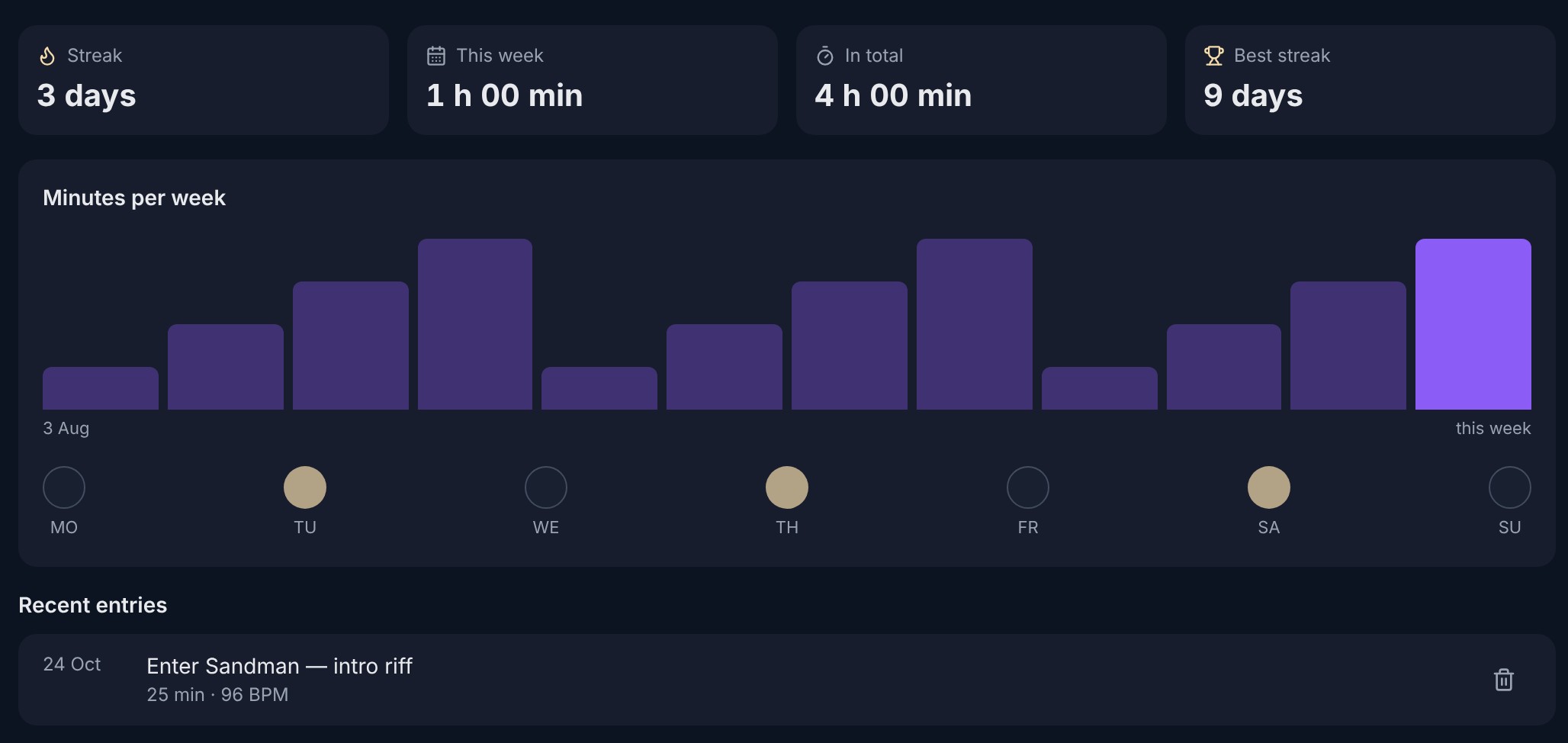
On Sonetum the diary fills itself in: the timer adds its minutes to whatever you're working on, the tempo log writes the BPM, and you get a streak, a weekly chart and a list of recent sessions. I look at the chart more than I'd like to admit.
A week, honestly
So that this doesn't sound like a brochure, here's what a real week of mine looks like with this system.
Monday: 20 minutes, riff at 96, clean. Tuesday: 20 minutes, got to 100, logged it. Wednesday: nothing, got home late, didn't pretend otherwise. Thursday: 12 minutes, back to 96 because Wednesday happened, up to 100 again by the end. Friday: 25 minutes, 104. Saturday: band rehearsal, which doesn't count as practice and I don't log it as practice. Sunday: 20 minutes, 104 held, started looking at the next section.
Four hours a week sounds like nothing. It's roughly 200 hours a year, done in a way where every one of them pointed at something specific. That is more focused practice than most people with a guitar in the corner get in five years.
Things that quietly ruin this
- Changing the hard thing every day. Pick one and stay on it for a week or two. The ladder only works if you keep climbing the same ladder.
- Logging tempos you didn't really hit. The number is for you. A flattering diary is worse than none.
- Practising only the song you perform next. Fine for a week before a show. As a lifestyle it's why your playing hasn't changed since 2019.
- Skipping the two minutes of fun. You'll think it's the optional part. It's the part that keeps the habit alive.
- Making it up on the weekend. A two-hour Saturday doesn't replace five missed twenty-minute days. It just gives you sore hands and a false sense of having caught up.
Start tonight
Pick one thing that's currently broken in your playing. Find the tempo where it works three times in a row. Write that number down somewhere you'll see tomorrow. Set a timer for twenty minutes.
That's the whole method. The tools help, and if you're on Sonetum the Practice tab was built for exactly this loop, but a kitchen timer and the back of an envelope will do. What matters is that tomorrow you start from a number, not from a feeling.