How to start your own label, and whether you should
The first time I typed a label name into the "label" field on a distributor's upload form, nothing happened. No one checked it. No fee, no registration, no form to fill in. The release went out with that name under it, and as far as Spotify was concerned, a label now existed.
That's the secret nobody tells you, and it's also why so many "labels" are just a word under a single. The name is free. Everything that makes the name mean something — the business, the contracts, the catalogue, the people who trust you with their music — is the actual work. This is a long one, because I want to cover all of it: whether you need a label at all, what it really is, how to set it up properly, what goes in a contract, and where the money goes.
Do you need one?
Probably not yet. Let's get that out of the way, because starting a label is the kind of thing musicians do instead of releasing music.
You don't need a label to release your own music. A distributor account in your own name does everything a label does for a single artist: delivery, codes, reporting, payment. A label name on top of that is a brand, and a brand with one artist and three singles is a logo.
You do need a label, meaning a real one, when any of these is true:
- You release music that isn't only yours: a friend's band, a side project with different members, your students, a scene around you. The moment money has to be split with people outside your own band, you need an entity that collects and pays, and a piece of paper that says how.
- You want the releases to belong to something bigger than one artist. A local scene, a genre, a city. People do follow labels; they follow Sub Pop or Ninja Tune or the tiny techno imprint whose every release they buy on Bandcamp, because the name is a promise about what's inside.
- You want to be the one who invests. Pay for someone's mastering, their video, their first ads, in exchange for a share of what comes back. That's a label deal, and it needs a label.
- You're releasing enough that the admin is already a job. At ten releases a year across a few artists you'll want the spreadsheets, the codes and the money in one place with one name on it.
And one reason that sounds good but isn't: "it looks more professional." Stores don't care. Playlist editors don't care. Listeners mostly don't notice. A self-released single with a great cover and a pitch looks exactly as professional as the same single with a made-up label name under it. The label earns respect by what it releases over years, not by existing.
So here's my honest test. If you're going to release other people's music in the next twelve months, start a label. If you're not, release your own music under your own name and come back to this later. The article will still be here.
What a label actually is
Strip the mythology away and a label is three layers, and you can build them in any order.
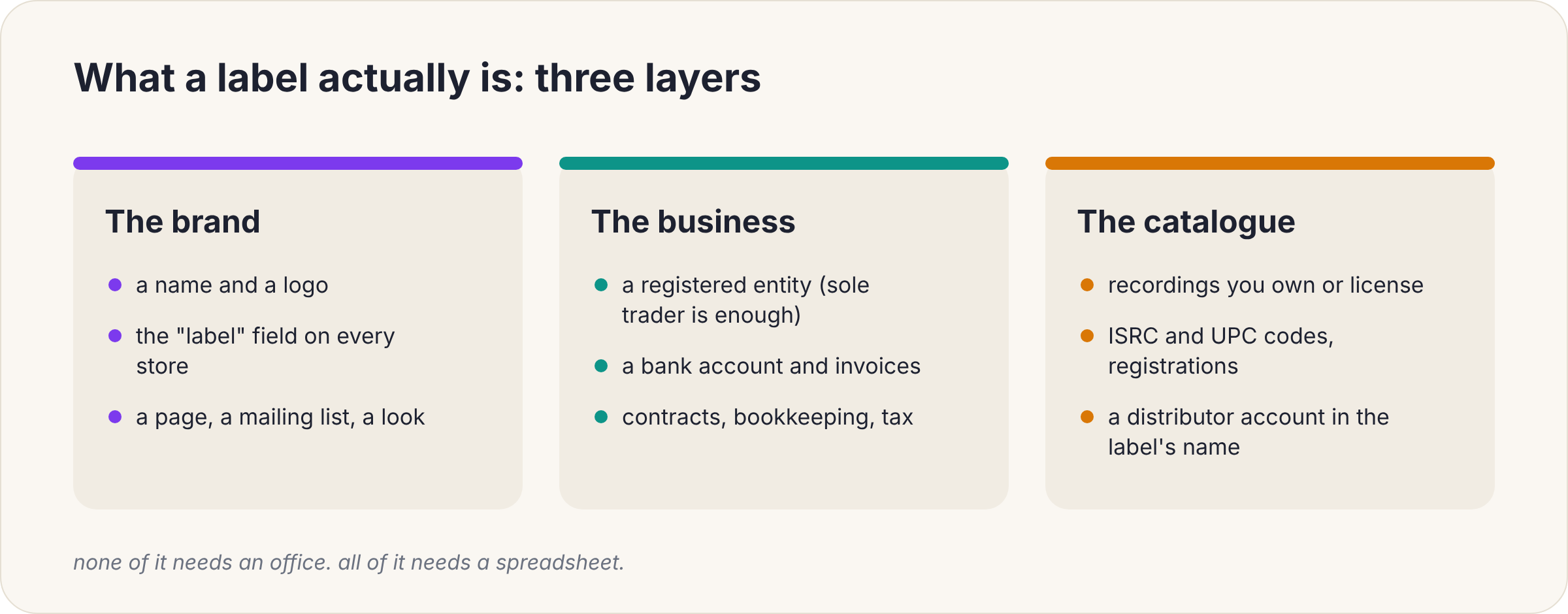
The brand is the part everyone starts with: a name, a logo, the "label" field on every store, a page somewhere, a mailing list, a look that holds the releases together. It's the cheapest layer and the one that matters least on day one. It matters a lot on day one thousand.
The business is a registered entity, a bank account in its name, invoices, bookkeeping and tax. It's the layer people skip, and it's the one that turns a word into something that can sign a contract, receive money and pay it out without everything running through your personal account and your personal tax return.
The catalogue is the actual asset: recordings you own or have the right to exploit, the codes that identify them, the registrations that make them earn, and a distributor account in the label's name that holds them all. A label with a catalogue of forty releases and no logo is a label. A label with a logo and no catalogue is a mood board.
None of it needs an office, staff, or a launch party. All of it needs a spreadsheet, and I mean that literally: one sheet with every release, every track, its ISRC, its UPC, its release date, who owns what share, and when the rights revert. Start it before the first release. You will not reconstruct it later.
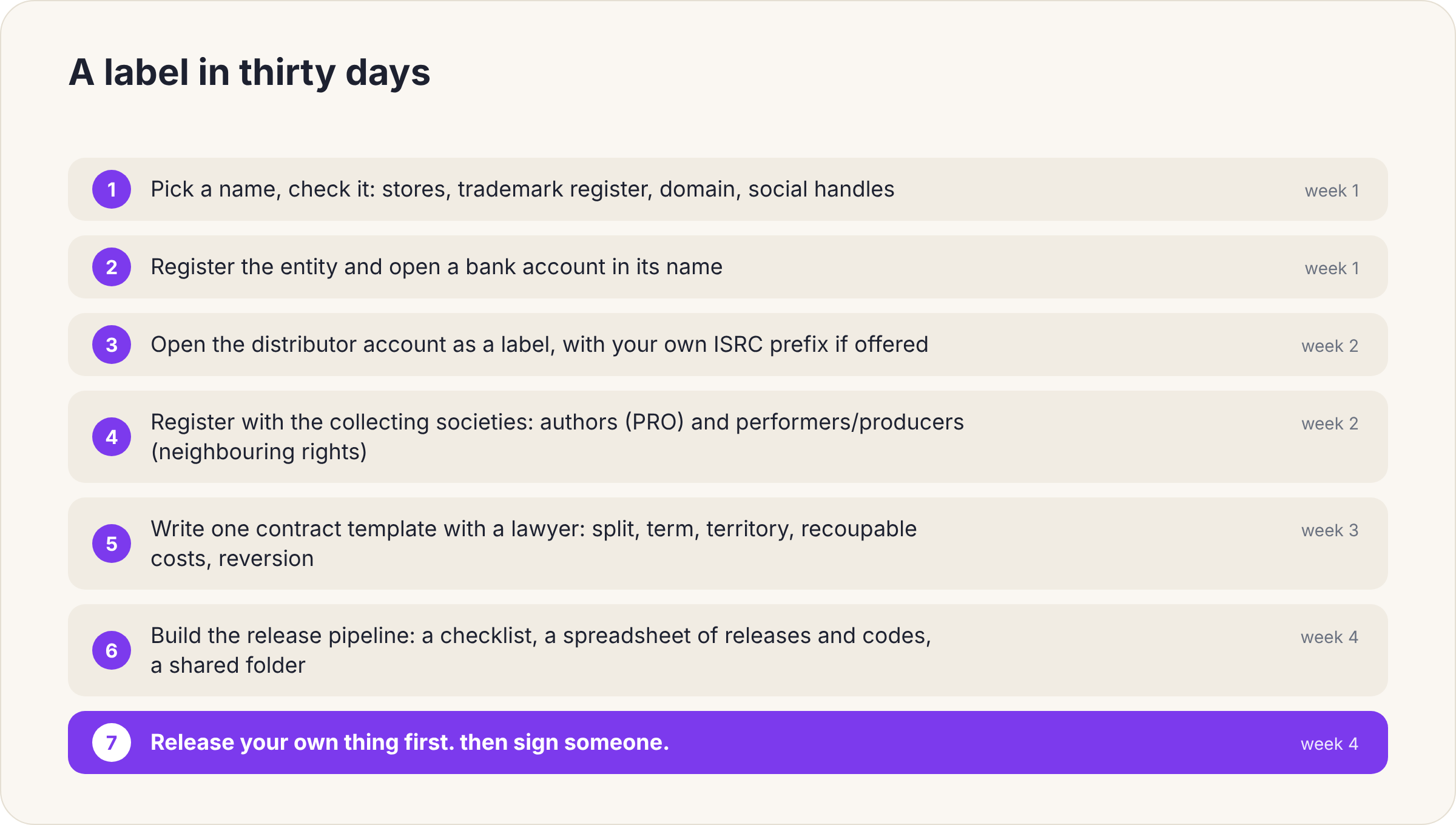
Setting it up, in order
Here's the order I'd do it in now, having done it in the wrong order the first time.
1. The name, and checking it
Pick something short that works as a word, a hashtag and a folder name. Then check it, in this order, before you fall in love with it:
- Search the stores. Open Spotify, Apple Music and Bandcamp and search the name. If a label with that name already has releases, it's taken, whatever the trademark register says. Two labels with the same name in the same store is a mess you'll be cleaning up for years.
- Trademark register. Your national one and the EU one (EUIPO) if you're in Europe, in classes 9 (recordings) and 41 (entertainment services). You don't have to register a trademark on day one; you do have to make sure you're not walking into someone else's.
- Domain and handles. The .com or your country's domain, plus the same handle on the two or three platforms you'll actually use. If "records" or "recordings" has to be added to make the handle free, that's normal.
- Say it out loud. To a friend, over the phone. If you have to spell it, pick another.
2. The entity and the bank account
This is the step that varies most by country, and the one where I'd spend an hour with an accountant rather than a week with forums. The general shape:
A sole trader / sole proprietorship registration (in my case the Serbian preduzetnik; the equivalents are autónomo, ИП, Einzelunternehmer, a UK sole trader) is enough for a small label. It's cheap, quick, and lets you invoice, receive money from a distributor and pay artists. Its weakness is that you and the label are legally the same person: the label's debts are yours.
A limited company separates you from the label, costs more to set up and run, and makes sense once there's real money, real contracts, or a partner. Many labels start as a sole trader and convert later. That's fine.
Whichever you choose: open a separate bank account for the label from day one, even if the law lets you mix. Every euro of label money goes in and out of that account and nothing else does. This is the single thing that makes the end of the year survivable.
Ask the accountant specifically about: how royalties from a foreign distributor are taxed; whether you need to charge VAT on anything (usually not on royalties, often yes on merch); and what to do with withholding tax on payments from US companies, which is where the W-8BEN form comes in. Every US-based distributor will ask for one; it's how you avoid 30% being withheld before the money leaves the country.
3. The distributor, as a label
Most distributors have a label tier: DistroKid's label plans, TuneCore's, Amuse Pro, ONErpm, and at a larger scale companies like Believe or The Orchard that only take labels with a catalogue. What you're looking for in a label account, beyond the store coverage I wrote about in the first-release article:
- Multiple artists under one account, with separate artist profiles and, ideally, separate royalty statements per artist, so you can see what each release earned without doing arithmetic.
- Splits: some distributors let you set a percentage per collaborator and pay them directly. For a tiny label this can replace half of your accounting. Check whether the split can be changed after release.
- Your own ISRC prefix. Your distributor will assign ISRCs for free, and that's fine to start. A label with its own registrant code (you get it from your national ISRC agency, usually cheaply or free) keeps its codes when it moves distributors, which it eventually will. Do this once you have more than a handful of releases.
- YouTube Content ID and SoundExchange / neighbouring-rights collection as options. More on that next.
Put the account in the label's legal name, with the label's bank account, from the start. Moving a catalogue from a personal account to a label account later is possible with most distributors but it's a support ticket per release.
4. The collecting societies
This is the layer that most self-releasing artists never set up and leave money on the table for years. There are two kinds of rights in every recording and they are paid separately, by different organisations:
The song (the composition, the lyrics) belongs to the writers and is paid through a performing rights organisation (PRS, GEMA, SACEM, SOKOJ, ASCAP/BMI, РАО and so on). Radio play, live performance, streaming and TV all generate "performance" and "mechanical" royalties for the song, and they don't come through your distributor. The writers register as members; the label, if it also acts as publisher, can register too and take the publisher's share. For a small label I'd leave publishing alone for the first year; it's a second business.
The recording (the master) belongs to whoever owns it, usually the label, and the performers on it. When it's played on radio, in bars, on TV, there's a separate neighbouring rights royalty for the recording, collected by a different society (PPL in the UK, GVL in Germany, OFPS in Serbia, SoundExchange for US digital radio, and so on). The label registers as the producer/rights holder and the musicians register as performers. Nobody does this for you, and it's the part of label income that grows with the catalogue even when streaming is flat.
So: as the label, register with the neighbouring-rights society for recordings. As a writer, register with the PRO for songs. Register each release with both, with the same ISRC the distributor used. It's an afternoon per society and a spreadsheet forever.
5. The contract
You need exactly one document to start: a template for a deal between the label and an artist. Get a lawyer to write it, or to review the one you draft; a few hundred euros here saves a friendship later. What it must say, in plain language and in this order:
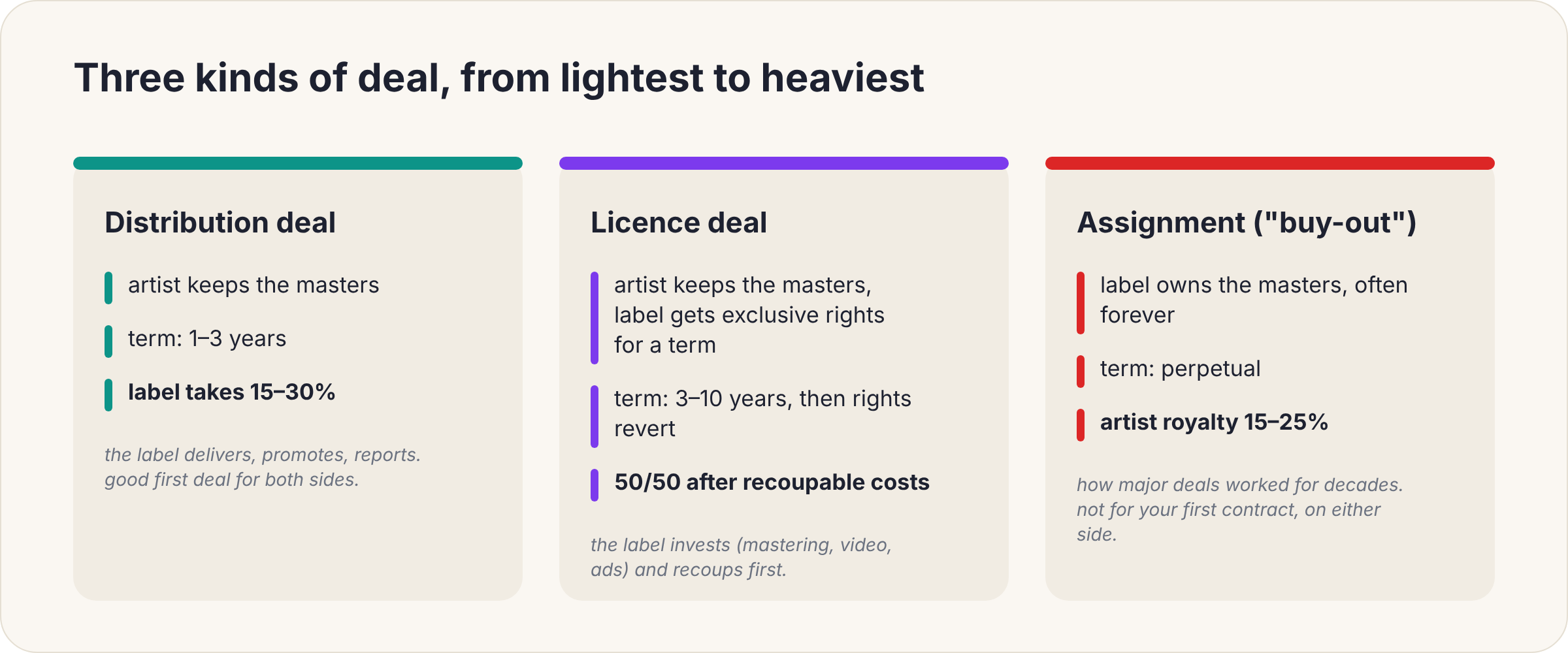
Which kind of deal it is. There are three, from lightest to heaviest.
A distribution deal: the artist keeps the masters, the label delivers the release, promotes it and reports; the label takes a percentage, usually 15–30%, for a term of one to three years. This is the right first deal for a tiny label and a friend's band. Everyone can walk away.
A licence deal: the artist still owns the masters but gives the label the exclusive right to exploit them for a term, typically three to ten years, after which the rights revert. The label invests (mastering, video, ads) and recoups its costs first, then splits what's left, commonly 50/50. This is what most independent labels actually do.
An assignment, sometimes called a buy-out: the label owns the masters, often forever, and pays the artist a royalty of 15–25%. This is how major deals worked for decades, and there are reasons for it at that scale. It is not a deal you should sign or offer as your first contract, on either side. If a label asks a young band to assign masters in perpetuity in exchange for "exposure," the band should leave.
The split and what it's a split of. Write the percentage, and write whether it's of gross (what the distributor pays) or of net (after agreed costs). Net is normal; the fight is over what counts as a cost.
Recoupable costs, listed. Mastering, video, pressing, paid promotion, with a cap or with approval in writing for anything above an amount. Not "general label expenses." Not the label's rent.
Term and territory. How many years, and "the world" unless there's a reason to split it.
What reverts and when. At the end of the term the rights go back to the artist, and the label delivers the files, the codes, and takes the releases down or transfers them. Write down which.
Accounting. Statements how often (quarterly is normal for a small label; semi-annual for bigger ones), payment within how many days of the statement, and the artist's right to see the distributor's reports.
Credits and approvals. Who approves the cover, the mix, the release date, the remixes. Who owns the artwork. Whether the label can sync the track to an ad without asking.
Signatures from everyone who owns a piece. Every band member, or the band's legal entity if it has one. A contract signed by the singer alone binds the singer.
Read the whole thing with the artist, out loud, before anyone signs. The point of the contract is that nobody is surprised in year three.
6. The release pipeline
The thing that makes a label feel like a label from the inside is that releases stop being events and become a process. Mine, in one line per step: master and cover received → entered in the sheet with codes → uploaded to the distributor six weeks out → artist profiles claimed → Spotify pitch three weeks out → pre-save and assets to the artist two weeks out → release Friday → registrations with the societies the following week → statement to the artist with the next quarterly round. The same checklist every time. The first-release article covers each step in detail; the label version is just that article, with a column for who does what.
7. Release your own thing first
Before the first signing, put out one or two releases of your own through the label. You find every hole in the pipeline on your own music, where the only person you can let down is you. Then sign someone.
Where the money goes
Here's the full path of a euro, because this is the part people picture wrongly in both directions: artists imagine the label is keeping everything, labels imagine they'll be rich.
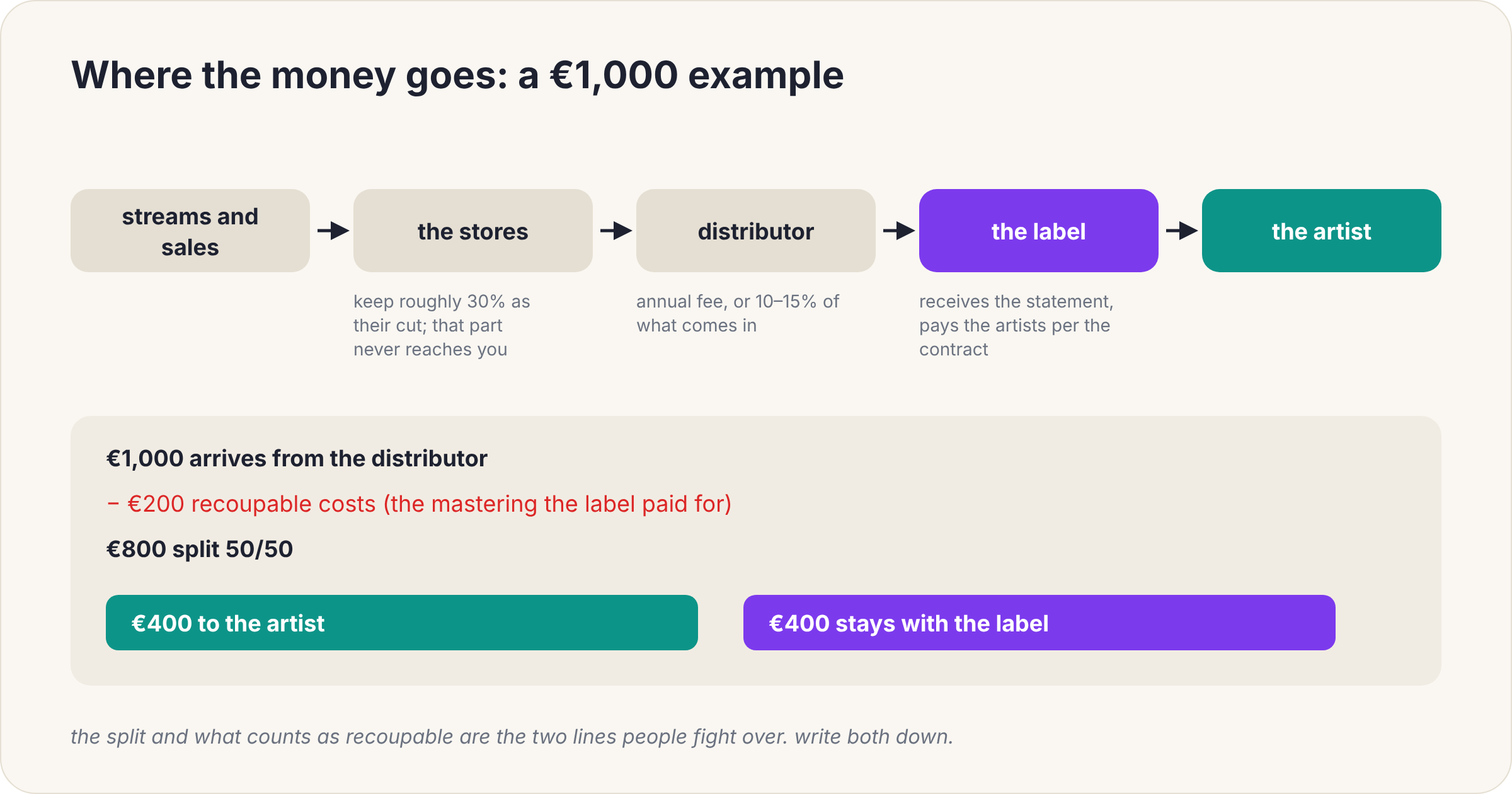
A stream happens. The store keeps roughly 30% of what it earned from that listener as its own cut; that part never reaches anyone in music. The rest goes to the distributor, who takes either nothing (if you're on a subscription plan) or 10–15%, and passes the remainder to the label with a statement, two to three months after the stream. The label records it, deducts whatever the contract says it can, and pays the artist their share, with a statement, within the agreed period.
A worked example with round numbers: €1,000 arrives from the distributor for an EP in a quarter. The contract is a licence deal, 50/50 net, and the label paid €200 for mastering, listed as recoupable. The label deducts €200. The remaining €800 splits: €400 to the artist, €400 stays with the label. The next quarter, with the mastering recouped, the split is 50/50 of everything.
Two things to notice. First, the artist's €400 is before their own tax, and the label's €400 is before its running costs, which at a small label are the distributor subscription, the accountant, the society fees and whatever promotion wasn't recoupable. A label doing twenty releases a year across five artists at this scale is roughly a part-time job that pays for its own coffee. That's not a complaint; it's the honest baseline, and it goes up with the catalogue, because the back catalogue keeps paying while you work on the next thing.
Second, streaming isn't the only line. For a small label the lines that actually add up are: streaming (steady, small), Bandcamp and merch (lumpy, bigger per unit, and Bandcamp lets a label have a page with every artist on it), neighbouring rights (grows with the catalogue, arrives once or twice a year in amounts that surprise people), and sync (rare, but one placement in a series can out-earn a year of streaming). A label that only looks at the Spotify number is reading one row of the spreadsheet.
Things that go wrong
In roughly the order they happened to me or to people I know:
- Signing before the pipeline exists. You promise a band a release date, then discover the distributor needs four weeks and the society registration needs a form you've never seen.
- A verbal 50/50. Fine until the track gets placed in a series and one person remembers a different number.
- Mixing accounts. Label money in a personal account means at the end of the year nobody can say what the label earned, and the artist statements become guesswork.
- Recoupable everything. A label that deducts its own time, its software subscriptions and a share of its rent before splitting is a label whose artists leave as soon as the term ends, and tell everyone why.
- Forgetting the societies. Years of radio and venue play that nobody collected, because nobody registered.
- Taking an artist you don't believe in because the release calendar had a gap. A label is only ever as good as its worst release.
- Making the label bigger than the music. The logo, the merch, the showcase night, the Instagram, before there are three records worth hearing. The order is records, then everything else.
The short version
A label is a brand on top of a business on top of a catalogue. The brand is free and the least important part. The business is an entity, a separate bank account and an accountant who understands royalties. The catalogue is the releases, the codes, the registrations and one spreadsheet that holds them all.
Start one when you're going to release other people's music; otherwise release your own and don't. Use a distribution or licence deal with a term and a reversion, never an assignment, with recoupable costs listed and a split of net written down. Register the recordings with the neighbouring-rights society and the songs with the PRO. Release your own thing first.
And then do the only thing a label is really for: find music that should exist, and make sure it does.