How to put on a small gig yourselves: the room, the budget, the tickets
The first show we put on ourselves lost €140, and I still think it was the best thing we did that year. Not because of the music, which was fine, but because for the first time nobody else decided when we played, who we played with, how much the door cost or whether we got paid. We did. We also learned where the €140 went, and the next one broke even, and the one after that paid for a rehearsal room for two months.
This is the version I wish someone had handed me before the first one: how to find a room, what it actually costs, how to sell enough tickets to cover it, and the handful of things that go wrong every single time.
First, decide what the show is for
It sounds obvious. It isn't. A show can be for money, for an audience, or for a recording, and those pull in different directions. A show for money wants a cheap room and a high door. A show to grow the audience wants a free or cheap door and two other bands who'll bring their people. A show to record wants a quiet room with decent sound and doesn't care how many people are in it.
Pick one. If you try to do all three you'll do none of them, and you'll argue about it in the van afterwards.
For most bands doing their first self-promoted gig, the honest answer is "audience, and don't lose money." That's what the rest of this assumes.
The room
You don't need a venue. You need a room with electricity, a toilet, and somebody who'll let you in. In roughly ascending order of cost and hassle:
- A rehearsal studio with a big room. Many have a hall they rent for showcases. You already know the owner, the backline is there, and the price is per hour. Capacity 40–80.
- A bar with a back room or a corner. They want a Thursday or Sunday filled. Often free if you bring people who drink; sometimes they'll even give you a cut of the bar. The PA is usually bad. Capacity 50–100.
- A community centre, a cultural centre, a school hall, a library. Cheap, sometimes free for local acts, nobody thinks of them, often surprisingly good acoustics. You'll need to bring the PA. Capacity 80–200.
- A small club. They do this for a living, which means they know the price of everything, including you. Expect a hire fee or a minimum bar spend, and a fixed slot. Capacity 100–300.
- Someone's garage, courtyard or garden. Free, memorable, legally fuzzy, and it's over at 22:00 when the neighbours call.
When you go to look at it, bring one bandmate and check five things: where the power is and how many circuits, whether there's a PA and whether it works, where people queue and where the money is taken, what time you can load in, and what the neighbours are like. Ask explicitly what happens if nobody comes. A good answer is "then you pay the hire fee." A bad answer is silence.
Get the date, the price, the load-in time and the curfew in a message, even a short one. Not because you don't trust them, but because in six weeks neither of you will remember what was said.
The budget, with real numbers
Here's the budget of a real small show, 80-capacity room, three local bands, €8 at the door. Your numbers will differ. The shape won't.
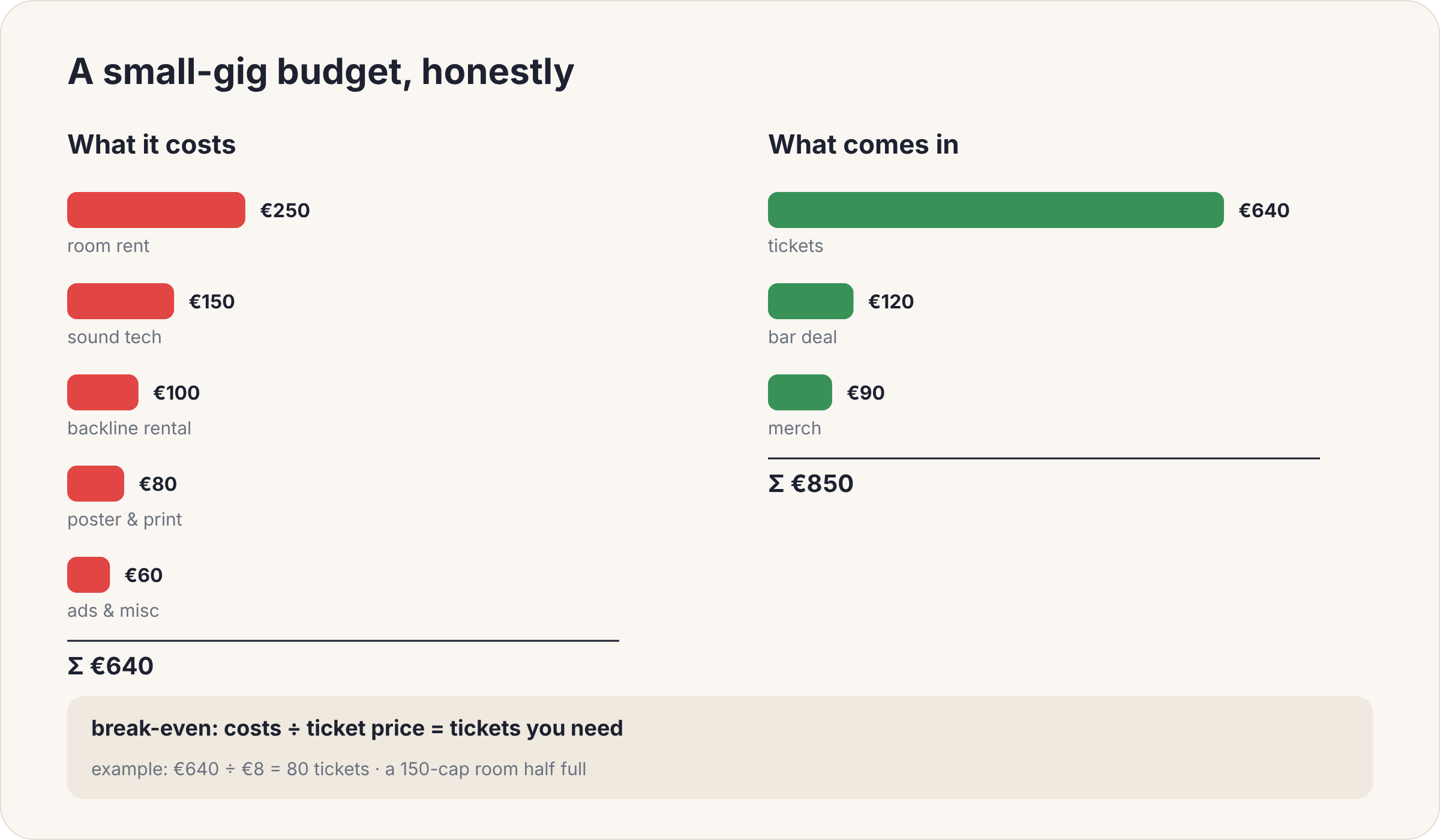
Costs
| Item | € |
|---|---|
| Room hire (4 hours + load-in) | 250 |
| PA and a sound person | 150 |
| Posters, printing, a boosted post | 100 |
| Van, fuel, parking | 80 |
| Drinks and food for the bands, misc | 60 |
| Total | 640 |
Income
| Item | € |
|---|---|
| 80 tickets × €8 | 640 |
| Merch (a few T-shirts, some CDs) | 120 |
| Bar cut, if the venue gives one | 90 |
Break-even on tickets alone is 640 ÷ 8 = 80 people, which is also the capacity. That's a bad plan: you only come out ahead if you sell out. In practice we fixed it three ways, and you'll want at least one:
- Negotiate the room down or find a cheaper one. Rehearsal studios and community halls at €100–150 change the whole picture.
- Borrow the PA from one of the bands or the studio. A sound person who's a friend costs a beer and a credit.
- Raise the door to €10 and sell most tickets in advance, so you know a week out whether you're in trouble.
A rule I use now: the total cost should be coverable by 60% of the room at the door price. If it isn't, cut costs until it is, or don't do the show. Not every show is worth doing.
The other thing the table doesn't show is who pays if it goes wrong. Decide this before you book anything. Usually it's the band that organised it, split evenly between members. Write it down in the band chat. The time to discover that your drummer assumed "the band" meant "you" is not after the show.
Three bands, not one
Unless you can personally bring 80 people, you need other bands on the bill, and you need them for one reason: each of them brings twenty or thirty friends who then hear you. A three-band bill with 25 people per band is a full room. One band with 25 people is a rehearsal with an audience.
Pick bands that are roughly your size and roughly your sound. A much bigger band will headline and their people will leave after they play. A totally different genre means the room empties and refills between sets. Split the door fairly and say how up front: an equal three-way split after costs is the most common and the least argued about. If one band is clearly the draw, give them a bigger cut and be honest about it.
Agree set lengths (30 minutes is plenty for an opener, 40 for a headliner), the running order, and who brings what backline. One drum kit, one bass rig, shared, with everyone bringing their own breakables. Changeovers should be 15 minutes, and they'll be 25.
Selling tickets
Selling tickets is not posting "show on Friday!" once and hoping. It's a six-week campaign, and most of it is personal.
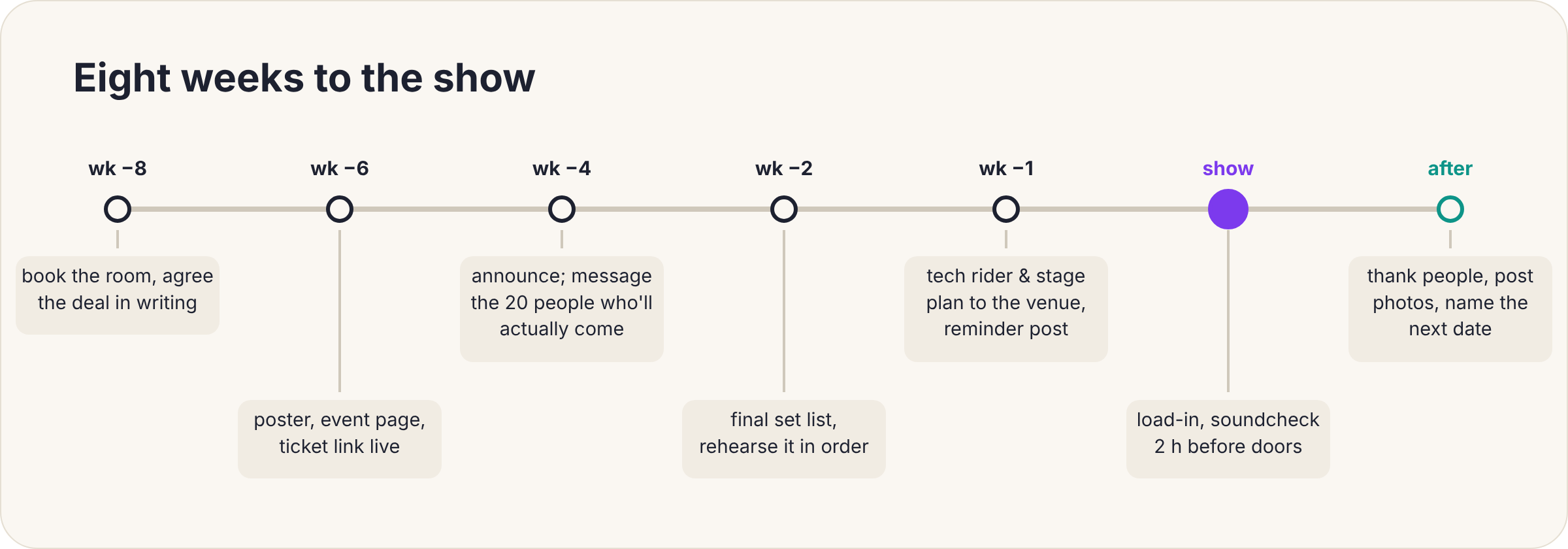
Advance tickets exist to tell you the truth. If you've sold 12 two weeks out, you know you need to work. If you're relying on the door, you find out at 21:30 on the night, which is too late. Use whatever is simplest: a ticketing platform with low fees, a bank transfer and a list, or physical tickets that bandmates sell by hand. The method matters less than having one.
Price in advance lower than on the door. €8 in advance, €10 on the door. It gives people a reason to commit, and the commitment is what fills the room.
The spreadsheet. Each band member writes down ten people they'll invite personally. Not a story post, a message. "Hey, we're playing on the 14th, I'd love you to come, here's the ticket link." Three bands × four people × ten names = 120 personal invites, and about a third of those come. That's your room right there. Everything else, the posters, the event page, the Sonetum event, the Instagram, is for the people who were already looking.
The event page. Make it on whatever your people actually use. Put the time of the first band, not the doors, so people turn up for the opener. Put the price, the address and a map. Update it once a week with something new: the running order, a video from rehearsal, the poster.
Posters still work, for one reason: a poster in the window of the rehearsal studio, the music shop and the two bars where your crowd drinks is seen by exactly the right people. Thirty posters is enough. Ten thousand flyers is not better.
The day
A rough running order for a 21:00 show:
- 17:00 load in, set up the shared backline, line check the PA.
- 18:00 soundcheck in reverse order: headliner first, so the opener can soundcheck last and leave the stage set for themselves.
- 19:30 doors. Somebody from the organising band is at the door with a float, the advance list and a way to take cards. Don't make that person the singer.
- 20:00, 20:45, 21:40 the three sets, with a 15-minute changeover written into the plan and announced from the stage.
- 22:45 settle up with the venue, pay the sound person, count the money in front of someone from each band.
- Load out, and leave the room as you found it, because you'll want it again.
A few things that go wrong every time, so plan for them: a band is late (have a number for every member), the PA has one dead channel (bring a spare cable, a DI, and a vocal mic), the card reader has no signal (take cash too), and the headliner's drummer wants to use their own kick pedal and it takes nine minutes to swap.
After
The next morning, before the hangover fully lifts, do three things. Count what came in and what went out and post the final numbers in the band chat, so nobody is guessing. Message the venue to thank them and ask about a date in three months. And post a photo and a thank-you to the people who came, tagging the other bands.
If you lost money, say so to each other without drama, and look at which line of the budget did it. Ours was the room. The second time we used a cultural centre for €90, kept everything else the same, and walked away with €230 and a date for the next one. The show was the same. The arithmetic was different.
That's really the whole skill. The music you already have. The rest is a budget, a list of names, and the willingness to stand at the door with a cash box for an evening.