How to adjust a truss rod without hurting your neck
I put off touching a truss rod for about six years. Everyone I knew had a story: a friend of a friend who "snapped the rod", a neck that "never came back". So every autumn, when my Telecaster started buzzing on the first three frets, I'd take it to a tech, pay for a setup, and watch him do thirty seconds of work with an allen key.
Then one day he let me do it myself, standing over me. It took a quarter turn. Here's everything he told me, plus what I've learned from doing it on my own guitars (and a few friends' basses) since.
What the rod actually does
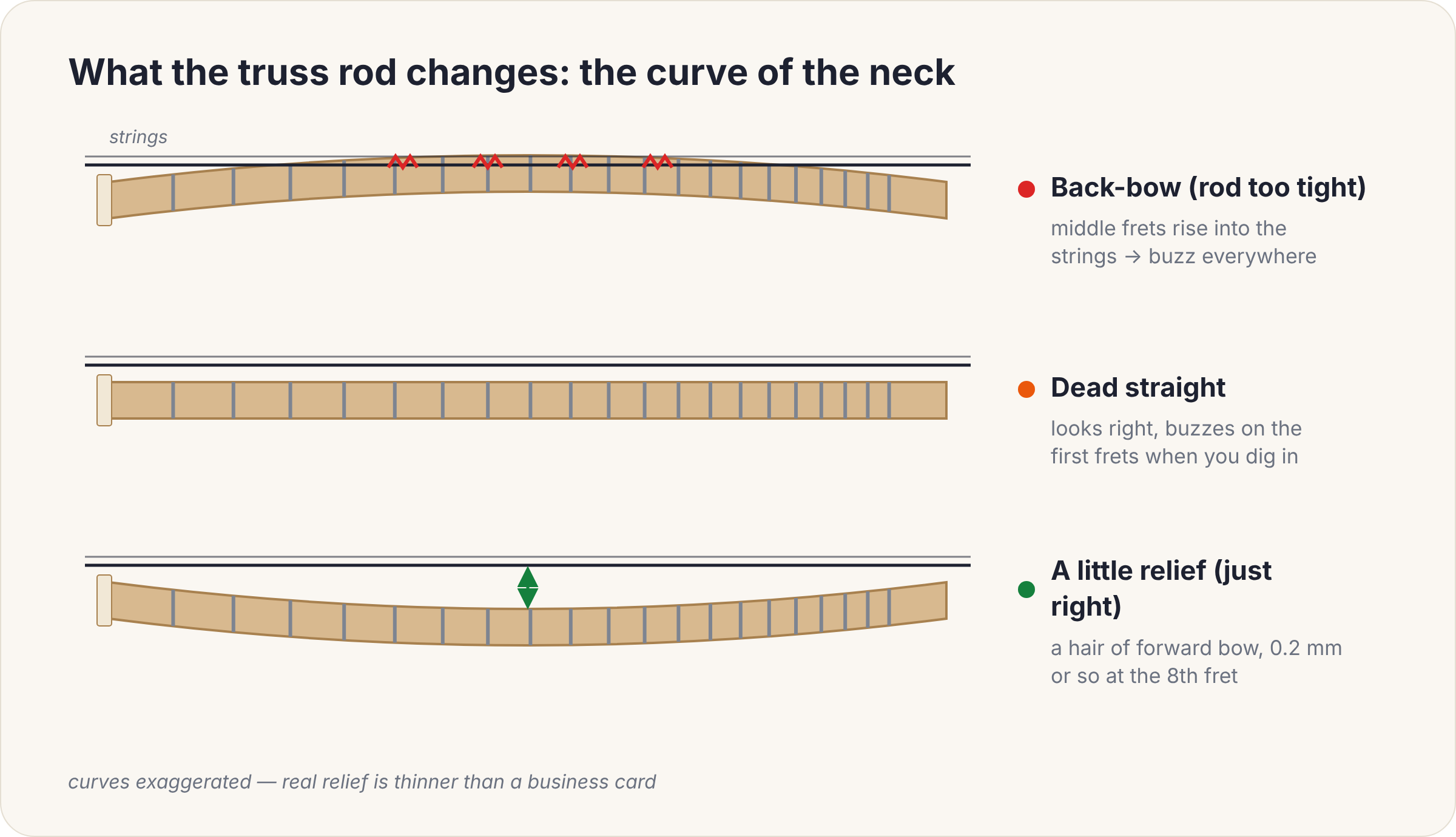
Strings pull. Six steel strings tuned to pitch pull on the neck with somewhere between 45 and 80 kg of force, depending on the set (light electric strings at the low end, acoustic 12s at the high end), and wood bends. The truss rod is a steel bar inside the neck that pulls the other way. Turn the nut one way and it pulls harder, so the neck straightens. Turn it the other way and it relaxes, so the strings win and the neck bows forward a little.
That's it. That's the whole job. It sets the relief: how much forward bow the neck has.
What it does not do is just as important, because this is where people get into trouble:
- It doesn't set your action. Action is mostly the bridge saddles (and the nut). If the strings are high all the way up the neck, the rod won't fix that.
- It doesn't fix one buzzing fret. That's a high fret. A rod turn will just move the buzz somewhere else.
- It doesn't fix a nut cut too high or too low.
- It doesn't bend the neck where it meets the body. Rods work on the middle of the neck, roughly frets 3 to 12. A hump at the 14th fret on an old acoustic is a different (and more expensive) conversation.
So before you reach for a key, be honest about the symptom. Buzz on the first five frets, clean higher up — that's too little relief, and the rod is your tool. High, stiff action in the middle of the neck, fine at both ends — too much relief, also the rod. Anything else, start somewhere else.
Step one: measure before you turn
This is the part nobody skips twice. If you turn first and look later, you don't know whether you helped.
Tune the guitar to pitch. Hold it the way you play it, not flat on a table — a neck sits differently on its back. Then:
- Put a capo on the first fret (or just hold the string down there with your free hand).
- Press the low E at the fret where the neck meets the body. On most electrics that's the 15th–17th fret, on a dreadnought the 14th.
- Look at the gap between the string and the top of the 7th or 8th fret.
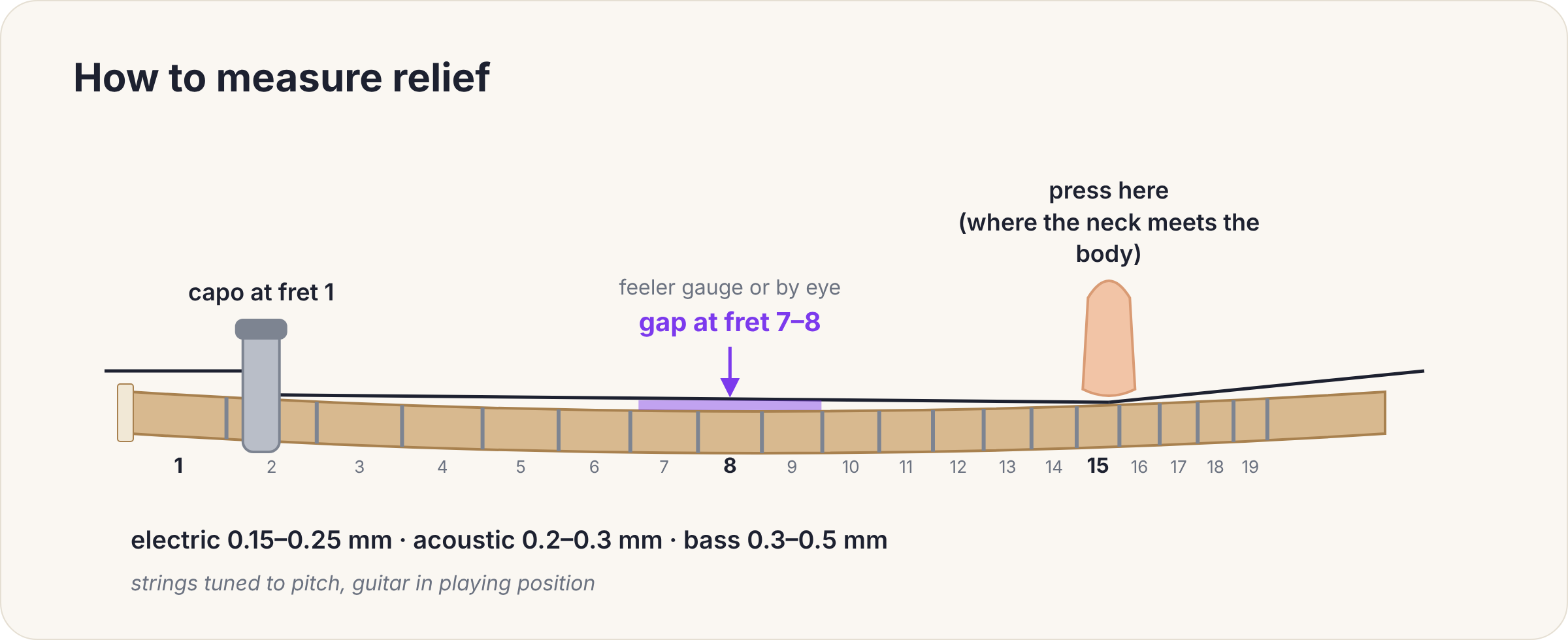
The string is now a straight edge, and the gap is the relief. Numbers people argue about, but these are safe:
| Instrument | Relief at the 8th fret |
|---|---|
| Electric guitar | 0.15–0.25 mm (.006–.010") |
| Acoustic | 0.2–0.3 mm (.008–.012") |
| Bass | 0.3–0.5 mm (.012–.020") |
A feeler gauge costs a couple of euros at a car parts shop and is the honest way to do this. Without one: tap the string down onto the 8th fret with a finger. If it moves a hair and clicks, you have some relief. If there's no gap at all, the neck is dead straight or back-bowed. If the gap looks like a business card thickness, that's about 0.25 mm, which is plenty for most electrics.
Write the number down. Seriously. Next year you'll want to know what "good" felt like.
Step two: find the nut and the right key
The adjustment nut lives in one of two places. Most modern guitars have it at the headstock, under a little plastic cover with two screws, or in an open slot right behind the nut. Vintage-style Fenders and some others have it at the heel, where the neck meets the body — you reach it from the body side, and on some you have to loosen the neck to get a screwdriver in. A few modern necks have a spoke wheel at the heel you turn with a thin rod.
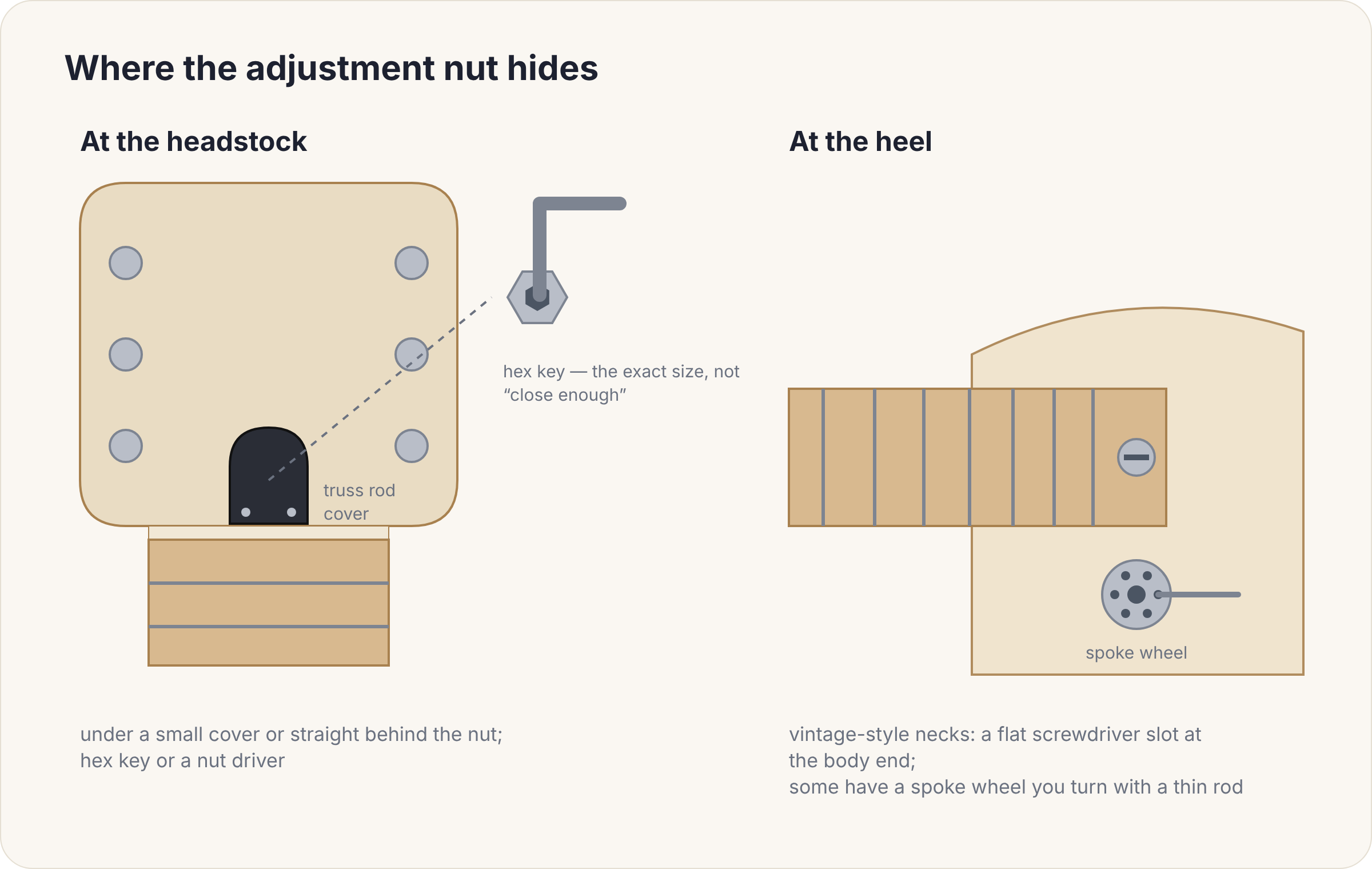
Now the part my tech was most insistent about: use the exact size key. Truss rod nuts are soft. A 4 mm key in a 5/32" socket, or a worn-out key with rounded edges, will chew the socket. Once it's rounded, you need a shop. Common sizes: 4 mm, 5 mm, 1/8", 5/32", 3/16", 7/32" — and nut drivers (5/16", 7 mm, 8 mm) on many Gibsons and acoustics. If the guitar came with a key, that's the one. If it feels even slightly loose in the socket, stop and find the right one.
Step three: which way, and how much
Looking at the nut from the end you're turning it from:
- Clockwise = tighten. The rod pulls harder, the neck straightens, less relief. This is what you want when the action in the middle of the neck is high and the neck has too much forward bow.
- Counter-clockwise = loosen. The rod relaxes, the neck bows forward, more relief. This is what you want when the first frets buzz.
Righty-tighty, like a bottle cap. It's the same for headstock and heel adjustments; what changes is which end you're looking from, so face the nut and then decide which way is clockwise.
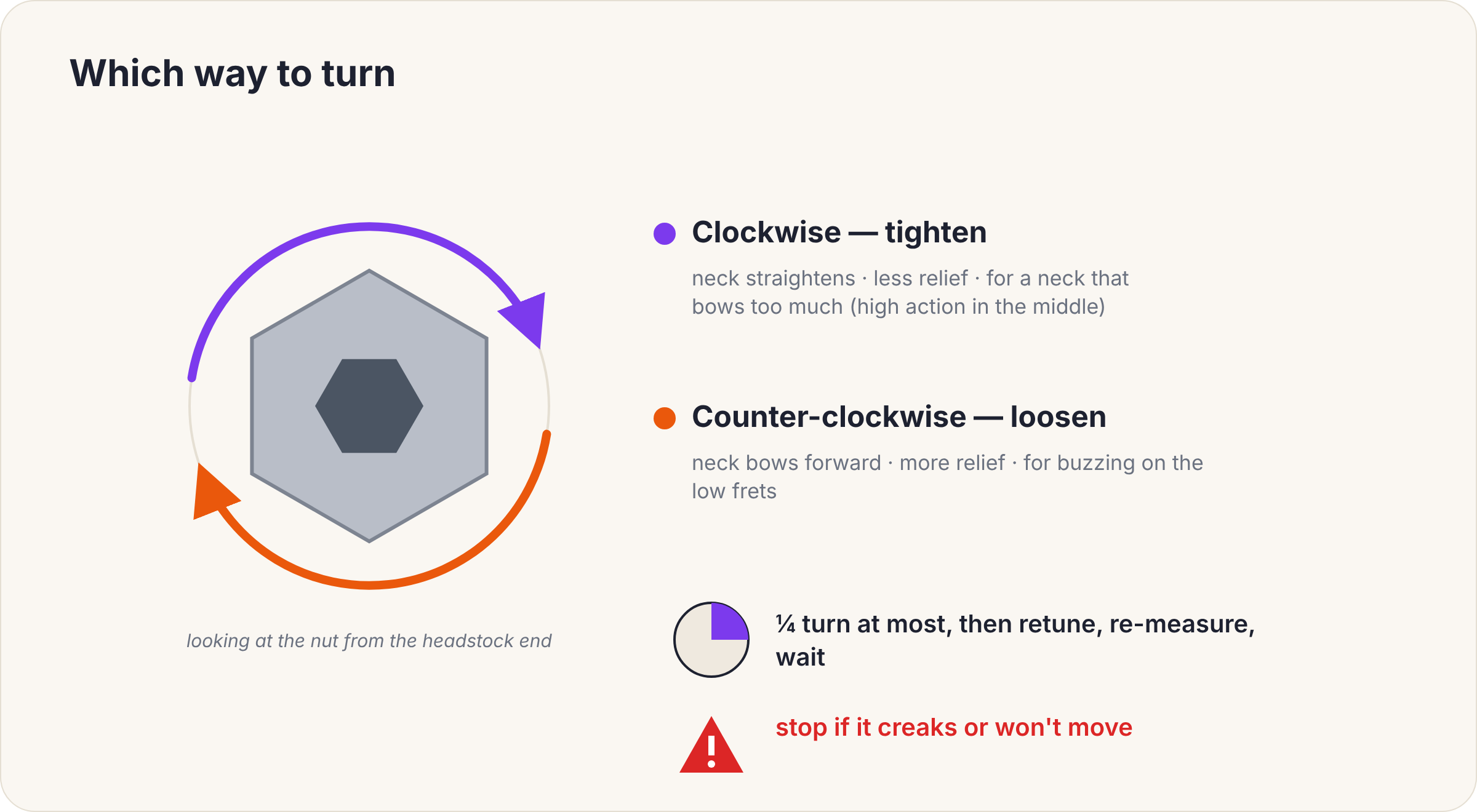
How much: a quarter turn at most, and an eighth to start. I know it feels like nothing. On most necks an eighth of a turn moves the relief by a visible amount. A full turn in one go is how necks get hurt.
If you're tightening, loosen it an eighth first and then come back past where you started. The nut often sits "stuck" in a bit of corrosion or finish, and breaking it free in the loose direction is gentler than cracking it tighter. Some people also slacken the strings before tightening, so the rod isn't fighting full string tension while you turn. Either way, tune back up before you measure, because the number only means something at pitch.
Then retune, re-measure, and wait. Wood moves slowly. On a thin maple neck you'll see most of the change in a minute; on a thick mahogany neck, or an old guitar that hasn't been adjusted in years, give it an hour, or overnight, before deciding you need more. I've overshot by being impatient more than once.
When to stop
Three things that mean stop and take it to someone:
- The nut won't move, or needs real force. Rods have a limit. If you're already near the end of the thread, more force just strips it.
- It creaks or clicks. A little tick as the nut breaks free is normal; a creak under load is not.
- You've done a full turn over a few days and the relief hasn't changed. The rod may be maxed out, or the neck may be doing something the rod can't fix.
And one that just means the rod is loose: on a single-action rod (most vintage-style necks), if you loosen all the way the rod goes slack and can rattle inside the neck. That's harmless; snug it back a touch. Dual-action rods, which most modern necks have, push both ways, so they don't do this.
When you'll need to do it again
Not often. Mine get touched maybe twice a year:
- Seasons. Dry winter air shrinks wood; the neck straightens and the low frets start buzzing. Humid summers do the opposite. If you live somewhere with real winters and no humidifier, this is just a thing you do in November and April.
- String gauge changes. Going from 9s to 11s adds a lot of pull. Expect to tighten a bit. Going down, loosen.
- A new guitar. It shipped in a box through three climates. Measure it before you blame anything else.
- Changing tuning for good, say to D standard. Less tension, less bow.
If you find yourself adjusting every week, something else is moving (or you're chasing a problem that isn't relief).
The order of a setup, in one line
Relief first, then action at the bridge, then intonation. Every time, in that order, because each one changes the next. If you lower the saddles and then turn the rod, you'll be lowering the saddles again.
That's really all there is. Ten minutes, a key that fits, a quarter turn, and the patience to let the wood catch up. The scariest adjustment on the instrument turns out to be the most forgiving one, as long as you measure before you turn and stop when something doesn't feel right.