Your first release on streaming: distributors, ISRC, the cover and the timeline
I put my first tracks on streaming this year, and the thing that surprised me wasn't how hard it was. It was how much of it was admin that nobody explains, and how many of the decisions I'd assumed were "later" turned out to be "before you upload." So here is the whole thing, in the order it actually happens, with the mistakes I made so you can make different ones.
This is about getting a finished recording from your hard drive onto Spotify, Apple Music, YouTube Music, Deezer, Tidal and the rest. It is not about recording it, and it's not about promoting it beyond the basics. Those are their own articles.
How it works, in one paragraph
You can't upload to Spotify yourself. Nobody can, except labels with a direct deal. Everyone else goes through a distributor: a company that takes your audio, your artwork and your metadata, checks them, assigns the identifying codes, sends the package to every store, collects the money the stores pay, and passes it on to you minus their fee. The distributor is also the one you'll argue with when something's wrong, so choosing one matters more than it looks.
Choosing a distributor
There are a few dozen. They differ in three things: how they charge, which stores they deliver to, and how good they are when something breaks.
How they charge. Two models, and you'll like different ones at different stages.
- Per release, keep 100%. You pay once per single or album, forever, and all the streaming income is yours. Good if you release rarely.
- Annual subscription, unlimited releases, keep 100%. A yearly fee covers everything you put out. Good if you release often. Watch what happens if you stop paying: with some, your music comes down.
- Free upload, they keep a percentage. No upfront cost, they take 10–20% of income. Fine if you expect nothing, and most first releases should expect nothing.
Which stores. This one bit me. Not every distributor delivers to every store, and the gaps are usually regional. If your audience is in a country with its own big platforms (Yandex Music and VK Music in Russia, for instance, or regional services in Asia and Latin America), check the store list before you sign up, not after the release is out and your cousin can't find it. The store list is usually a page on the distributor's site. Read it with the countries that matter to you in mind.
Support. When the release goes to the wrong artist profile, or the ISRC is attached to the wrong track, you'll want a human within a day or two. Search "[distributor name] support" and read the complaints before you choose. Every distributor has them; the question is whether they're about speed or about silence.
Names you'll come across: DistroKid, TuneCore, CD Baby, LANDR, Amuse, ONErpm, and regional ones that are often the best choice for a regional audience. I'm not going to rank them, because it depends on where your listeners are and how often you release, and because they change their pricing roughly once a year. Pick for store coverage first, then the pricing model that fits your release rate.
The codes: ISRC and UPC
Two codes, and you'll be asked for both.
ISRC identifies a recording. One per track. It's how the stores know that your single and the same track on your album are the same recording, and how royalties get attributed. Format looks like QZ-ABC-26-00001.
UPC (or EAN) identifies a release: the single, EP or album as a product. One per release.
The good news: your distributor assigns both for free if you don't have them. Leave the fields empty and they'll generate them. The only reason to bring your own is if you've already registered them elsewhere (a previous distributor, a label, a national ISRC agency) and want continuity. If you're switching distributors and re-releasing the same recording, reuse the old ISRC; it keeps the play counts attached to one recording instead of splitting them.
Write the codes down somewhere once the release is live. You'll need them for registering with a collecting society, for licensing a sync, and for the inevitable day when you move distributors.
The audio
What the stores want is less than people think.
- WAV, 16-bit or 24-bit, 44.1 kHz is accepted everywhere. 24/48 is fine too. Don't upload an MP3; it gets re-encoded and you lose twice.
- Loudness: aim for roughly −14 LUFS integrated with true peak at −1 dBTP. Spotify, Apple and YouTube normalise everything to around that level anyway. A master slammed to −7 LUFS gets turned down and ends up sounding smaller than a dynamic one, which is the opposite of what the loudness war promised.
- Starts and ends: no more than a second or so of silence at the top, a clean fade or ending at the bottom. Some stores reject a file with a long silent intro.
- Explicit lyrics: there's a checkbox. Tick it honestly. A missed "explicit" flag is one of the most common reasons a release gets pulled after it's live, and an unnecessary one keeps you out of some playlists.
If you don't have a mastered file, get one mastered. An AI mastering service is fine for a first release and costs about as much as a coffee; a human engineer costs more and is worth it the moment you care.
The cover
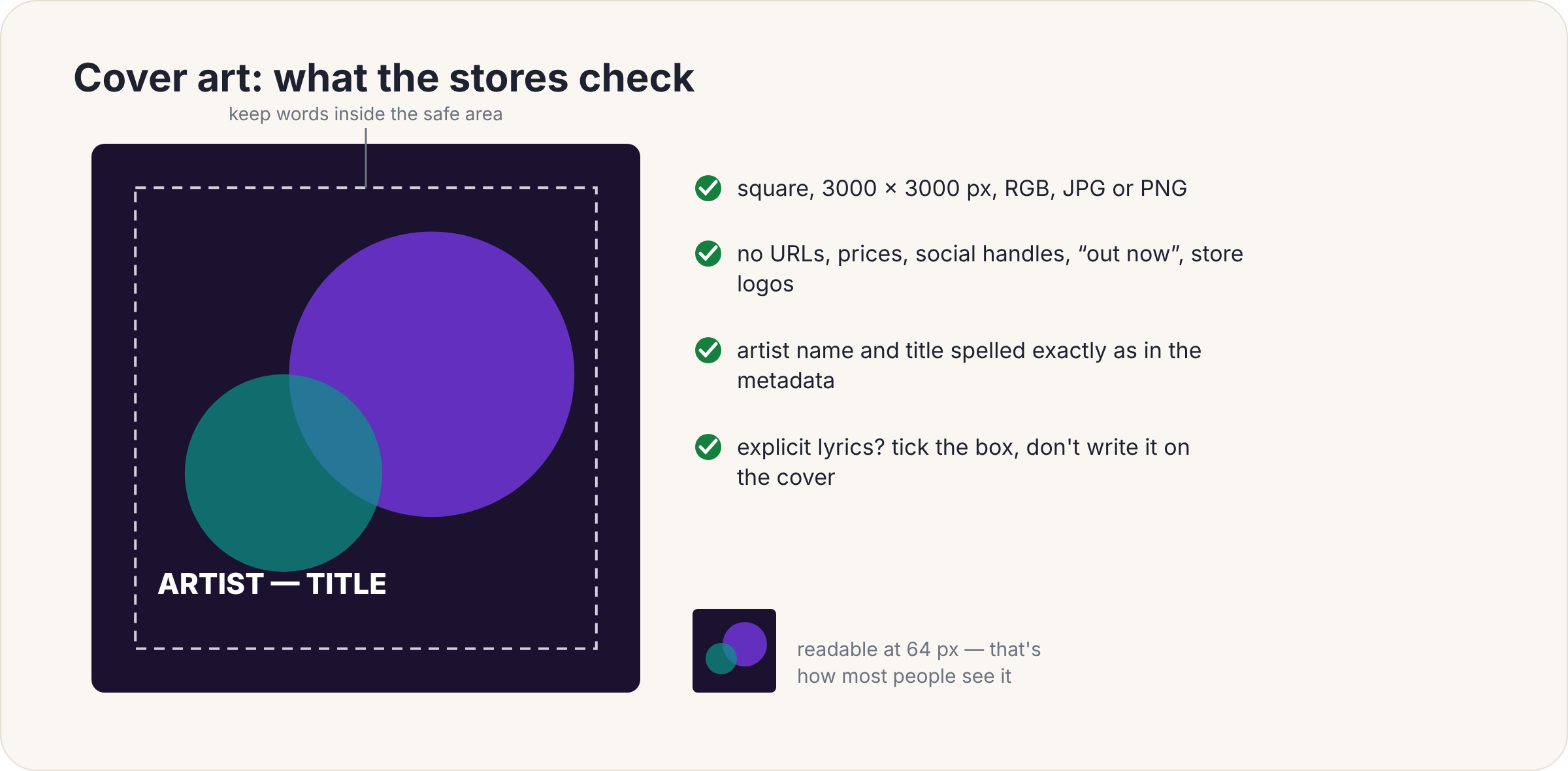
The cover gets rejected more often than the audio does. The rules are mechanical and the same everywhere:
- Square, 3000 × 3000 px minimum, RGB, JPG or PNG. Not 1500. Not 2999.
- No text that isn't the artist name and the title. No "out now," no URLs, no social handles, no prices, no "available on" with store logos. That last one gets rejected every time.
- The artist name and title on the cover, if present, must match the metadata exactly. "The Weekend" on the cover and "The Weeknd" in the form is a rejection.
- Nothing you don't own. A photo from the internet, a famous painting, a brand's logo, anything that looks like a famous film poster. Also nothing that's visibly a template with the placeholder still in it; it happens.
- It has to read at 64 pixels. That's the size it's shown at in a list on a phone. Look at your cover as a tiny thumbnail before you commit. If the title is unreadable at that size, that's fine, but the image itself should still say something.
Blurry, low-contrast or pixelated covers get rejected as "poor quality," and the review is partly automated and partly a human with a queue of thousands, so make it obvious.
The metadata, where the small mistakes live
You'll fill in a form. Every field matters, because every field goes somewhere.
- Artist name: exactly as it should appear, forever. Capitalisation, spacing, "the" or no "the." Changing it later is possible but painful.
- Featured artists go in the artist field as features, not in the title. "Song (feat. X)" in the title is the single most common metadata rejection.
- Title case rules exist and are enforced: "Nothing Else Matters," not "NOTHING ELSE MATTERS" or "nothing else matters."
- Songwriter credits: full legal names of whoever wrote it, not stage names. Required by law in many places and required by most stores.
- Genre: pick what listeners would call it, not what you'd call it.
- Language of the lyrics, and "instrumental" if there aren't any.
- Release date: see below.
- Original release date, if you're re-releasing something that came out before.
Go slowly on this page. Then have someone else read it.
Timing: the six weeks before
This is the part that would have saved me the most grief. Everything on the stores' side takes longer than you think, and the two things that matter most for a first release, the artist profile and the Spotify editorial pitch, have hard deadlines.
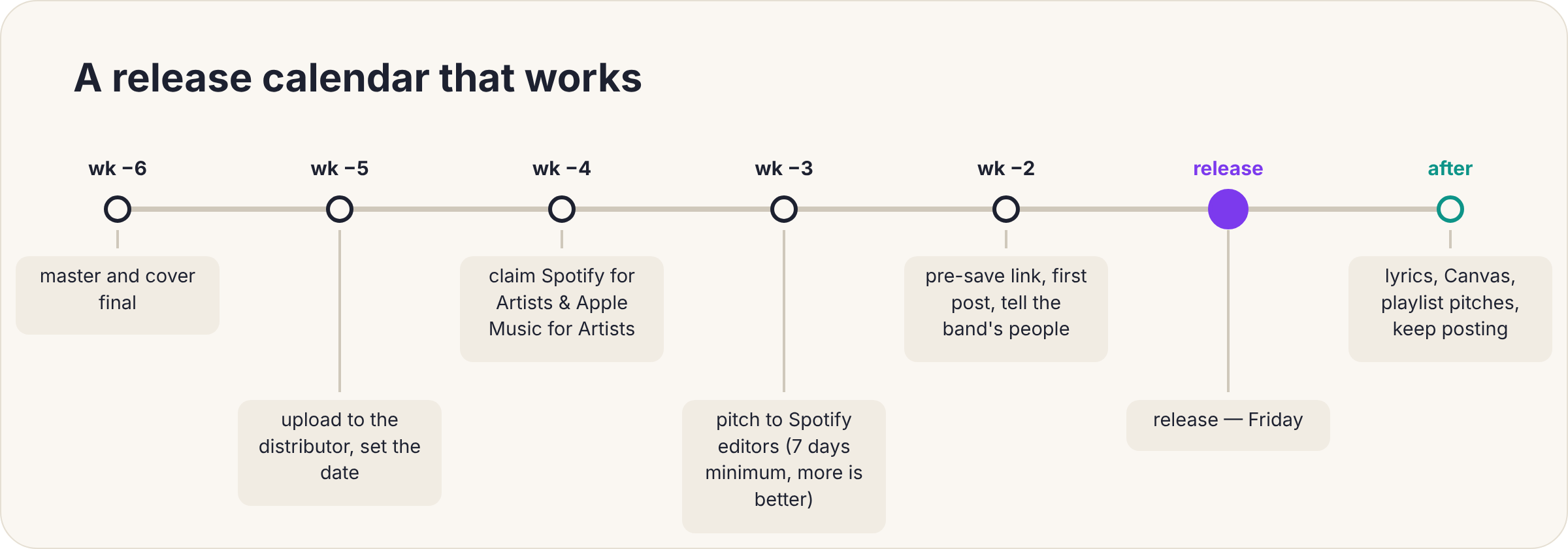
Week −6: finished master, finished cover. Not "nearly."
Week −5: upload to the distributor and set the date. Delivery to the stores takes a few days to two weeks depending on distributor and store, and reviews can bounce the release back. Set the release date at least four weeks out. Yes, it feels like forever. It's the difference between a release and a surprise.
Week −4: claim your artist profiles. Once the release has been delivered to the stores (your distributor will tell you), you can claim Spotify for Artists and Apple Music for Artists. This gives you the profile photo, the bio, the stats, and, crucially, access to the editorial pitch. If this is your very first release, you can't claim a profile before something is delivered; that's why the upload comes first.
Week −3: pitch to Spotify's editors. From Spotify for Artists, one track per release, at least seven days before release and realistically two to three weeks. This is the only official way into editorial playlists, and it also feeds the automatic "Release Radar" playlist for your followers, which for a small artist is the one that actually matters. Write it plainly: what the song is, who it's for, where you're from, what's happening around it. Nobody reads the fourth paragraph.
Week −2: pre-save link and the first post. Your distributor or a free tool gives you a single link that opens the right store on each person's phone. Post it, and message it to the people who'd care, personally.
Release day: a Friday. The industry releases on Fridays, and the weekly charts and playlists refresh around then, which is the reason everyone will give you. The real reason to do it is simpler: release day is a day you want to be free to answer messages, and a Friday evening is when people listen.
After: keep going. Add the lyrics (Musixmatch for Spotify, through the distributor for Apple). Make a Spotify Canvas, the looping short video; it's quick and visibly raises saves. Pitch to independent playlist curators directly, never through anyone who charges for placement. Post about it more than feels comfortable; the people who'd like it mostly didn't see the first post.
Money, briefly and honestly
A stream pays somewhere between a third of a cent and half a cent, depending on store and country. A thousand streams is a few euros. Your first release will most likely earn less than the distributor fee, and that is completely normal and not a verdict on the music. The release exists to give you a profile, a catalogue, a link to put in a bio, and a place for the hundred people who like you to actually press play.
Income arrives two to three months after the streams happen, because the stores report late and the distributor pays after them. Don't plan around it.
If you want to be paid for the songwriting as well as the recording (they're separate rights, separately paid), you'll need to register with a performing rights organisation in your country and register the song there with the same ISRC. It's a separate process, it's worth doing once you have a few releases, and it's not urgent for the first one.
The short version
Master and cover finished six weeks out. Upload five weeks out, date set four weeks out, on a Friday. Claim the artist profiles the moment the release is delivered. Pitch to Spotify's editors at least a week before, more if you can. Check the store coverage before you choose a distributor. Let them assign the codes. Keep the cover clean and the title case right.
None of it is hard. All of it is specific, and the stores do not forgive vagueness. Do it once properly and the second release takes an afternoon.